A small survey with only 40 valid responses changed how I think about the difference between having equipment and actually being prepared.
My original question was simple: our school has an AED, but do students actually know where it is? I expanded that question into a survey about campus AED availability and first-aid awareness.
I eventually received 40 valid responses. Forty is not a large sample, so this survey cannot represent all schools in Shanghai. I see it more as an exercise in learning how to ask a question, collect data, and understand what the data can say. The survey covered school type, campus size, number of AEDs, training, maintenance, and whether students knew where AEDs were located. I then tried a simple regression analysis in R Studio.
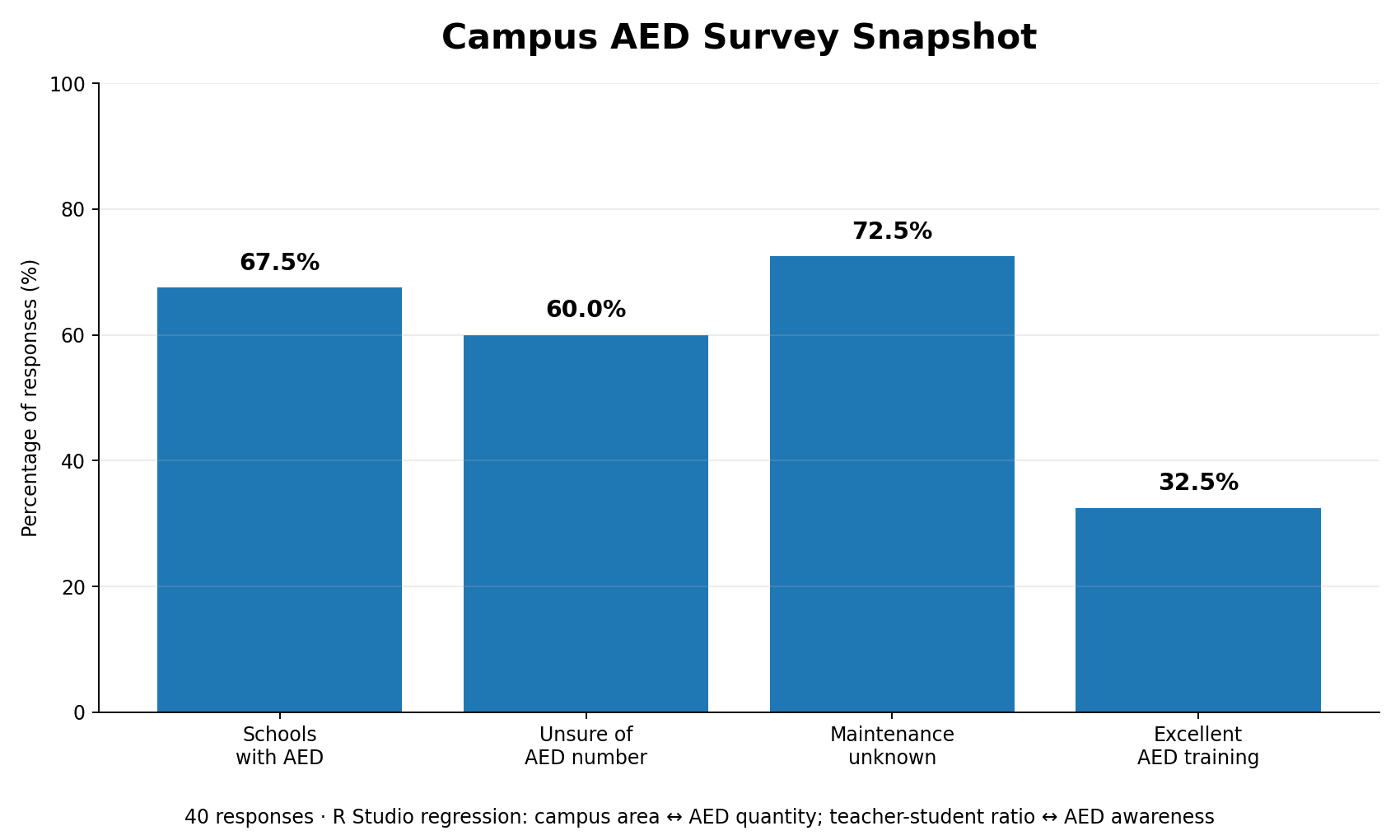
In the survey, 67.5% of respondents said their school had an AED. However, 60% did not know how many AEDs the school had, and 72.5% did not know whether maintenance records existed. I began to see that “having an AED” and “being prepared for an emergency” are not the same thing.
Within this limited sample, campus size showed a noticeable association with the number of AEDs, and student-teacher ratio also showed some association with AED awareness. But I do not want to turn those correlations into causal claims. Forty responses are far from enough for that. My biggest lesson was that data can help answer questions, but it can also tell you which conclusions you are not yet entitled to make.
If I have the opportunity, I would like to expand the sample and learn more about AED location, signage, maintenance, and training across schools. My question has shifted from “Does the school have an AED?” to “If someone actually collapses, are we prepared?”
A small sample can reveal clues, but it should not make me rush to conclusions. Correlation is not causation.